
Skokholm Island Long-term Volunteering 2027
Lockley Lodge Visitor Centre,
Marloes,
Pembrokeshire, SA62 3BJ
Skokholm Wardens
There are two 2027 positions running from 29th March until 2nd July and two from 2nd July until 1st October.
29th March until 2nd July
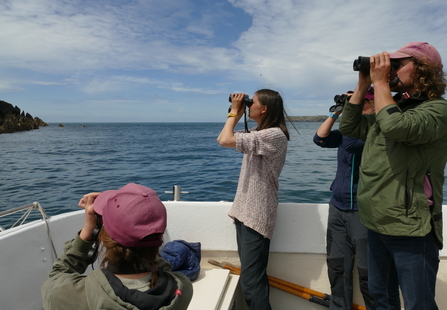
Spring is a fantastic time to be on Skokholm. The weather can be wild, cold and wet but suddenly there are signs everywhere that breeding seasons are fast approaching. Dark nights see the first of our 175,000 breeding Manx Shearwaters return to the Island. Quickly the nights become a cacophony of whaling noises. The first spring migrants begin to pass through and the Puffins return. From then on, evenings are spent counting the large rafts which congregate around the Island. The Razorbills and Guillemots return to the cliff ledges and the gulls begin to lay their eggs. Days are spent counting the nesting seabirds and seeing how the totals fluctuate each day. Nights are spent taking guests to see the phenomenal Storm Petrel colony at the Quarry. A subset of the Manx Shearwater population is monitored by playing their song into burrows and you will take on the responsibility of setting up the Fulmar productivity plots. Moth trapping and the morning census of migrant and resident birds provide a break from the seabird monitoring. Choughs are secretive around their nests which means staff find themselves hiding among the rocks to look for incubation changeovers. The Peregrines and Ravens are more straightforward, as is the mapping of the vocal Oystercatchers. Much of our time is spent establishing seabird study plots. And, as the spring progresses, monitoring a sample of each breeding species; this will be the basis of our productivity estimates. If Puffins have occupied the Crab Bay Hide boxes, you will be taking our guests to see the action. All this, coupled with a long-term Puffin colour ringing project, a study of Manx Shearwater survival rates and the daily ringing of passage birds makes for a full-on but very rewarding time.
2nd July until 1st October
Our second team of long-term volunteers pick up where the first team left off. The productivity monitoring plots are established and most of the chicks have hatched, but we need to follow the progress of the Fulmar, Razorbill, Puffin and gull chicks to see if they fledge. A large amount of time early on in the period is spent playing Storm Petrel song along several transects, allowing us to estimate occpancy. The staff take turns during several 24 hour periods to assess how many of the Puffins arriving with fish lose their chick food to the gulls. Many more visits are made to the Puffin study colony to try and see as many colour ring combinations as possible. If the weather behaves, evenings are spent ringing adult Storm Petrels which often goes on until the early hours. Attention turns to the Manx Shearwaters in August. Visits are made to our study plots to ring the chicks and monitor their development and fledging. A small number of Storm Petrel nests are also monitored throughout this period. More effort is spent seawatching for cetaceans and scarcer seabirds, and moth trapping is at its peak. Autumn migration picks up pace as August progresses which means our daily census begins to take longer. If the pond has dried out then there could be several days of hard digging as we continue to remove the sediment which has built up over the decades. September is an exciting month and much time is spent in the field counting common migrant birds and searching for scarcer ones.
Further information
This is a fantastic opportunity to work on one of Britain’s most spectacular Islands and to gain experience in a wide range of survey techniques. But it is not all about the monitoring work! The successful applicants will be integral to all aspects of Island management, from cleaning visitor accommodation to helping with boat deliveries and physical island management. Skokholm relies on bigger groups of volunteers for managing its infrastructure but your help will be needed too. In the spring, work concentrates on getting the accommodation ready for guests (so lots of cleaning, painting and lime-washing). In the autumn work usually focuses on the Lighthouse and other specific projects.
Each volunteer has their own bedroom at the Farm and share the same facilities as our paying guests. We are therefore looking for people who are happy to spend time with our guests and share their passion for the phenomenal wildlfie which inhabits Skokholm. You are responsible for providing your own food and transportation as far as the boat (WTSWW can help with the latter). However, grants are available from the Seabird Group and the British Trust for Ornithology YBOV scheme. The Friends of Skokholm and Skomer also offer a small bursary at the end of your stay, in exchange for an article for their biannual newsletter.
No qualifications or specific experience are required as training will be given on the Island. However, candidates who are working towards a career in conservation are preferred. Additionally candidates who have previous conservation volunteering experience, island experience, relevant qualifications such as a ringing permit or who are experienced birders will be well placed. We are looking for people with enthusiasm for UK wildlife who have a desire to learn and get involved in a range of tasks. Candidates must be of a hardy nature as working days are long and in a range of weather conditions. Monitoring work will sometimes involve loud playback lures and much of Skokholm’s path network and seabird study plots are near steep cliff-tops.
The 2027 Whole-Island Storm Petrel Census
Every ten years or so, all suitable Storm Petrel nesting habitat on Skokholm is surveyed using tape playback; the last survey was completed in 2016. The 2027 whole-island census is likely to overlap both volunteering periods, and you will play a key role in this work.
How to apply
Please fill in the application form explaining why you are interested in the post, what you could bring to it and what you hope to achieve from the position. No cover letters or CVs will be included as part of your application.
Applications must reach the below address by email or post by midnight on Sunday 10th January 2027.
Shortlisted candidates will be contacted for a remote interview during the week following the closing date.
Please e-mail or post your application forms to Giselle and Richard.
Email: skokholmwarden@gmail.com
Post: Wildlife Trust of South and West Wales, Welsh Wildlife Centre, Cilgerran, Cardigan, SA43 2TB
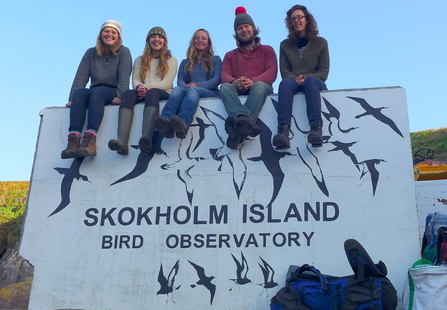
Richard Brown and Giselle Eagle
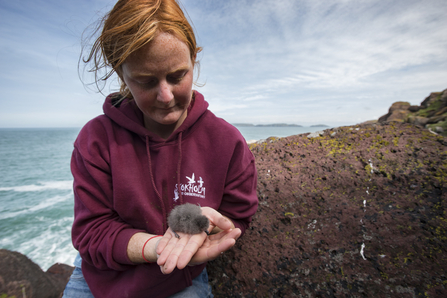
Richard Brown and Giselle Eagle
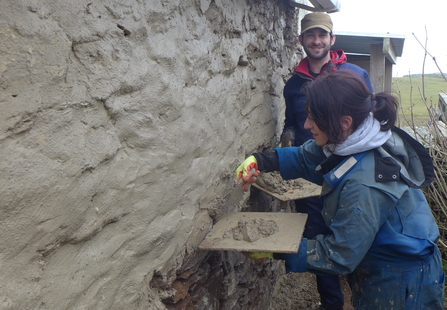
Richard Brown and Giselle Eagle
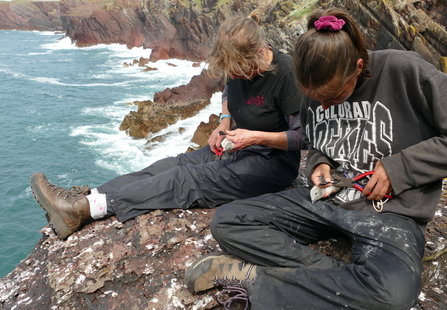
Richard Brown and Giselle Eagle
Richard Brown and Giselle Eagle